Monday, 2 April 2018

The death of Johanna Wollheim, and the marriage of Ludwig Wollheim

Johanna Wollheim

This was a surprise: the death certificate for Johanna Schiff, née Wollheim. The surprise being that it states that she professed no religion at the time of her death. Dated 13th May 1876, it gives her birthplace at Lissa, now Leszno in Poland. It states, as we would expect, that she was the wife of Leopold Schiff, and the daughter of Jacob Wollheim and Nanny Löwenthal. Her mother is variously named in the records as Nechle, Nechama and Nägele, obviously all variants, reflecting Yiddish, Hebrew, German and assimilatory influences over time.
I am at present unable to decipher and thence translate all the handwriting in this document.


Ludwig Wollheim

A marriage certificate, the husband being Ludwig Wollheim,and I think it reads that he was a merchant in Trieste, born 9th July 1830, and the son of Solomon Wollheim and Enrichetta Bernheimer. He married Helene Weissweiller in Frankfurt on 29th April 1864. She was born on 19th February 1840 and her parents were Leopold David Weisweiller and his wife Johanna. Ludwig was the nephew of Johanna Schiff.


I have received the following translations kindly provided by my friend Claudia Petersen of Hamburg.

Death Certificate Johanna Schiff:
No. 737
Hamburg, May 13, 1876
Today presented himself to the registrar who signed this document
The lawyer Jacob Lazarus, Dr. jur.
Living at                        Winterhude, Bellevue
And declared that his mother-in-law, Johanna Schiff née Wollheim
66 years of age, without religion (faith)
Living at                       Winterhude, Bellevue
Born at                         Lissa, having been married to the pensioner Leopold Schiff, deceased,
Daughter of the deceased married couple Jacob Wollheim and Nanny née Löwenthal
At                                 Winterhude
May 12 of the year 1876
In the afternoon at 11:45 o’clock
Died.
Read, accepted and signed
Dr. Lazarus
The registrar J.W. Hansen


Wedding register
April 29, 1864
Wollheim, Ludwig, merchant from Triest, born at Triest on July 9, 1830, son of Salomon Wollheim and Enrichetta Bernheimer, both deceased,
And
At the margin: Banns put up April 2, 1864, fol. [foglio] 135
Weisweiller, Helene, cancelled from the association of citizens [?];
Born here on Feb. 19, 1840,
Legitimate daughter of the local citizen and merchant Leopold David Weisweiller and his wife Johanna née Ellissen [Ellißen]
Were married here civilly
Friday, April 29, 1864.
Witnesses were:
1.)   Julius Löwengard, citizen of our town and Director of the German Phönix [fire insurance company]
2.)   Dr. jur. Michael Manhayn, citizen of our town and lawyer

Signatures:
Ludwig Wollheim, as bridegroom
Helene Wollheim née Weisweiller
Dr. Manhayn as witness [1800-1878, Frankfurt, Member of the Constituent Assembly in Frankfurt 1849/1850, Member of the Parliament of Frankfurt 1851/ 1854-1858]
Julius Löwengard as witness [Julius Löwengard was the founder of the German Phönix in Frankfurt.]

For attestation: D. Schrader, Dr. [I guess, not easy to read]

Saturday, 31 March 2018

Mahler and the Schiff Family: a new link

I have already written about Mahler's friendship with the three Schiff sisters in Hamburg. [http://schifffamilytrieste.blogspot.co.uk/2013/10/leopold-schiff-and-his-eldest-daughter.html]

Yesterday I received a fascinating email from my cousin Mary-Lu providing another aspect to the Mahler-Schiff friendship. She wrote:
Did I tell you the story about Mahler which I had from my mother? Apparently her mother, Lucile Newell Schiff, Samuele's (Carlo) third child, and second daughter, always said that when she wrote her autobiography she would tell that aged 4 she was carried up to bed on Gustav Mahler's shoulders. Maybe this was on one of the occasions when Gustav was spending Christmas with Henriette/Emma who would have been aunt to my granny: he could have gone to supper with Carlo or maybe they were staying with the ladies. I am so glad to have this other confirmation of the connection with Mahler. 
And I quickly replied:
Almost certainly Lucile met Mahler in 1892 when he came to London as a guest conductor from 26th May to 23rd July. The dates are perfect. Lucile was born 27th February 1887 so she would have been five. I am sure the three Schiff sisters in Hamburg would have given the introduction. Mahler was in Hamburg from 26th March 1891 till 1897, and his friendship with the Schiff sisters was strongest at the beginning of his sojourn.
There is another link. revealed in the autograph book of Rosie Schiff, daughter of Alfred Schiff. She must obviously have been on another visit to her three aunts in Hamburg, for her autograph book, which was sold at Sotheby's for £6,875 in 2012, has Mahler's signature with the inscription: 'Auf Wiedersehen in London!', Hamburg, 24th March 1892. He left Hamburg on 26th May 1892, in order to travel by ship to London. Perhaps it was Rosie, as much as her aunts, who, having met Mahler at their house in Hamburg, arranged to meet him in London at the home of her uncle Charles at 22, Lowndes Square. Rose Georgette Schiff was born in 1874, and was staying with her aunts in Hamburg in August 1891, as she signed the visitors book at Toni Petersen's on July 31st 1891. When Mahler signed her autograph book she would have been almost eighteen years old.

There are other sources of information about this visit, such as this interesting lecture on YouTube:

This is an interesting site about Gustav Mahler:


Lucile Schiff at the time of her meeting with Gustav Mahler. Painted by Julian Russell Storey in 1892.

Thursday, 15 March 2018

La Famille de Salomon Schiff


Le premier ancêtre dont nous connaissons le nom avec certitude est Samuel Schwalbach, de Hanau. Né à Hanau après la mort de son père, lui aussi Samuel, d'où son prénom, suivant la coutume ashkénaze, il a été marié à l'orpheline Augusta Fuld de Mannheim, qui sans doute lui a apporté une dot considérable. Après ce mariage il a changé son nom de famille de Schwalbach à Schiff, mais ce nom de famille n'a pas été complètement oublié ou par la famille ou par les autorités.
Ce couple a donné la vie à une fille et à quatre fils : l'aîné s'appellait Léopold, le deuxième Adolph, le troisième Salomon, et le cadet Samson, mon propre ancêtre. Léopold est devenu commerçant, Adolph était professeur de langues, Samson suivait la profession d'orfèvre, et Salomon, apparement le plus intelligent, est devenu médecin en 1832. Né à Mannheim en 1805, il s'est marié le 4 mai 1837 avec Caroline Zimmern, d'une bonne famille juive aussi de Mannheim. Leur fils Rudolph est né le 2 avril 1838. Quand il avait l'âge d'un an son père Salomon est mort, laissant ce fils plus une femme enceinte. Son petit frère Friedrich Salomon (prenant ainsi le prénom de son père décédé) est né le 16 juillet 1839, mais à ce moment nous en perdons toute trace.
Quant à Rudolph, il nous réapparaît à son mariage à la chrétienne Maria Anna Josepha Kunkel le 24 juillet 1866 à Feudenheim, une banlieue de Mannheim. Leurs quatres enfants étaient Mathilde, née à Francfort en 1867, Otto, né en 1869 lui aussi à Francfort, Élise, née à Bruchsal en 1871, et Franz Salomon, né à Mannheim en 1876.
On ne sait pas quand cette famille est arrivé à Paris, mais Rudolph a été reconnu par l'état comme 'officier de l'instruction publique' avant sa mort en 1918. De ses enfants, jusqu'à maintenant de Mathilde nous ne savons rien à part de son mariage à Baptiste Faugeras, d'Otto j'ai découvert sa vie parisienne de musicien et compositeur, d'Elise je viens de découvrir récemment quelques détails de sa vie, surtout concernant son mariage à l'avocat juif polonais Roman Flatau. Franz Salomon s'est marié à l'âge de 19 ans avec Julie Oppenheim, qui paraît d'être la fille d'une couple juive. Franz et Julie avaient trois filles: Octavine, Lucienne et Yvonne. Tous les trois mariées, Octavine a beaucoup de descendants en France, Lucienne a laissé de la famille en Chile et aux États Unies, et Yvonne elle aussi a laissé des descendants aux États Unies.

Friday, 9 March 2018

Elise Rosa Barbara Caroline Schiff

Elise was the daughter of Rudolph Schiff and his wife Maria Anna Josepha Kunkel. I believe she was born at Bruchsal in August 1871, the third of four children, her siblings being Mathilde, Otto the composer, and Franz Salomon, who has left many descendants. The records state she was born on August 16th, but her Polish residence permit gaves the date as August 19th.
She married Roman Flatau in Paris in the autumn of 1901. Roman was born in Plock, north west of Warsaw, and close to Poznan (then Posen in Prussia) on April 18th 1867. They presumably went to live in Poland after their marriage, but to what had been a German-speaking part of the country. 
Marriage Banns for Roman and Elise. Roman's mother was in fact Anna (Yiddish Hinde) Heyman. Keimann seems to be a misreading.

I have so far been unable to trace if they had any children, though I know that Roman was trained as a lawyer, and thus was given the title Doctor, and was buried in 1933 at Taverny in the north-west suburbs of Paris. He came from an illustrious family, his father being a wealthy banker and philanthropist. His brother Edward was a very famous neurologist, and his brother Julian was a renowned chemist and pharmacist, and professor at Poznan university. There was also a sister Helena. Edward remained Jewish throughout his life, Julian became a Protestant, and Roman and his wife are recorded as being Roman Catholic. Their father Ludwik remained Jewish though strongly supporting assimilation.


Residence record from Poznan for 1923 for Roman Jan Flatau, son of Ludwick and Anna, and Elzbieta Rosa née Schiff 

Bruchsal, her birthplace not far from Mannheim, was where Elise's great aunt Hange Maier lived, and where her great grandmother Augusta Schiff had gone to live on the death of her husband Samuel in 1827, until her own death in 1845.


I have not been able so far to trace any other information about Elise, such as details of her death.


"The documents are complemented by photo plates and glass plates from 1935-1958 and other materials, among which one deserves particular attention: anonymous denunciations for Aleksandra Flatau, and a 30-year contract for extending the validity of the tomb of her uncle Roman Flatau, issued to her by the mayor of Taverny in France in 1959."
This is an important and valuable essay in Polish about the Flatau family.


These documents appear to refer to Roman Flatau but need some analysis and explanation. Poznan was part of Germany until the end of the First World War, when it returned to Poland after over a hundred years. It is possible that this is a different Roman Flatau but it seems unlikely. Roman's birthplace was Plock, which was indeed part of Russia until it was returned to the new state of Poland after the First World War.


1892


1894. Christina Freer had no connection with Roman: her occupation was 'wife'. She would have been travelling to join her husband in America.

USA naturalisation 1889, after ten years


Julian Flatau

Edward Flatau


As for Henryk Flatau, I can find little about him, but this may be a memorial to him:

HENRYK FLATAU

and Janina Helena Flatau

daughter of Jakub Neumark

and Bronisława from d. Szyffer

Issued [?] by peasants
shot by the Nazis
from whom they hid
in Rabka on February 8, 1943.


In the mortgage book of Osada Anitra there are two men named Flatau - Julian and Henryk. We decided to follow them, finding the entire scientific dynasty among the representatives of whom both Julian and Henryk appear. Are these the same Flatau, who were immortalized in the mortgage registers of Letniska Milanówek, unfortunately it remains a puzzle for now, although circumstantial evidence indicates that it may be about them.
Professor of chemistry Julian Flatau was born in 1870 in Płock or Warsaw. He gained a very careful education, he studied, among others in Berlin, Vienna and Zurich. After graduation he worked in Bern and the Sorbonne in Paris, and then in Warsaw, where he collaborated with the paint factory. In 1914 he left Warsaw, going to Moscow. After World War I, he moves to Bydgoszcz, and then to Poznań, where he is the head of the Department of Medical Technology at the University of Poznań. He has not returned to Warsaw. Can it be Julian, whom we are looking for? Possibly. During his stay in Warsaw, he was able to purchase a property in nearby Letnicka Milanówek.  
However, we decided to look for Mr. Flatau more connected with Warsaw. Here, after a short search, it was possible to record success. A resident of Warsaw was a famous physician, one of the founders of the foundations of modern neurology Edward Flatau. He was born in 1868 in Płock, where his family was one of the most significant for the city (the palace remained after them, currently serving as a wedding palace). Edward Flatou was educated in Berlin and Moscow. At just 26 years old, he published a brain atlas that gained international recognition. Sigmund Freud himself was to say that the photos contained in the atlas are a great educational material. In 1899 Edward Flatau rejected the proposal to take the neurology department in Buenos Aires and lived in Warsaw, dealing with, among others, spinal cord research and discovery of the Flatau law.
Considering that there were many scientists in the then Letniska Milanówek, it can not be ruled out that Edward Flatau also visited here, visiting another representative of the Flatau family, Henryk, who owned a villa here. Only who was Henry? Here the search turned out to be much more difficult than in the case of Edward. The mystery was only explained by the article by Stanisława Mysłakowska "Borowin during the occupation", placed in the Podkowia Cultural Warehouse. It is written there that during the Second World War a widow of dr. Hid in Podkowa Leśna. Edward Flatau, whose daughter left the hideout in Podkowa to join Uncle Henryk, who lives in Rabka. So Henry Flatau was the brother of Edward Flatau. For a deeper search it turned out that he was also a doctor, although much less known than his famous brother.
Were the flatau men in question really connected to the pre-war Milanówek? In the picture placed on Wikipedia in the biography of Joanna Flatau, daughter of Edward Flatau, there is a picture of her childhood signed "presumably in Konstancin". Maybe this is not Konstancin at all? Or maybe it is in the pre-war Milanówek that one should look for completely different men of Flatau.    


This may refer to Henryk and Helena, who apparently qualified as a doctor:
Warsaw telephone Directory 1939/40

'Kurjer', 1908, Lublin
"The national parcel bank for the Kingdom of Poland. We have before us the act of the national parcel bank established in Warsaw for the Kingdom of Poland, headed by two thoroughly acquainted with this activity, the citizens of Płock land, pp. Henryk Flatau and Antoni? Kowalewski. The bank is assumed to be a parent company with broad financial support. It aims, among other things, to defend against buying land in the Kingdom of Poland by the Germans and to facilitate the transfer of landed estates into small hands."

Among medical science: Karl Goldstein, Ludwik Hirszfeld, Samuel Goldflam, Mieczysław Minkowski, Henryk Flatau, Juliusz Strassburger, Leopold Landau ...

"A photograph of the Flatau family inside the orangery located on the property in the 1880s. Obtained thanks to Ms. Krystyna Grochowska (from the family descendants of the Flatau family from Paris)"

From 'Concordia: Le Corréspondant Internationale', 1900. Courtesy of Vincent Sanfuentes


Sundry notes translated from the Polish


Ludwik Flatau - a merchant, later he became a member of the landed gentry, founder of the Flatau Jewish Old People’s Home; the chief representative of the Płock circle of assimilationists. Edward Flatau (1866-1932) – Ludwik’s son, a doctor, scientist, one of the most prominent Polish psychiatrists, a co-creator of the Polish School of Neurology.

His wife was Anna Flatau née Heyman (died on July 4, 1898 in Płock [9]), with whom he had five children: Roman, Edward, Julian, Henryk, and daughter Helena. He lived with his family on Kolegialna street at number 11 [10] [11]. Ludwik and Anna were the owners of the city of Bieżuń [12] in the years 1875-1876. He belonged to the Enlightenment movement, which assumed the spreading of knowledge and education among Jews, including Płock [13].

The plot of May 28, 1820, he bought Bartłomiej Turski from Teodor Dohman for 12 thousand. 150 Polish zlotys. From Turski, the plot was taken over by Kazimierz Turski in 1832 for 12,000. Polish zlotys and it was his hands that became the property of the Flatau family. Turski gained 13.5 thousand on the transaction Polish zlotys. It is known that in 1835 Joachim Flaau's estate consisted of an empty square intended for residential development, and before there was a small fruit garden and a large vegetable garden. When his first wife died, her husbandthe man remarried and bought "property at ul. Collegial under number 321 ". - Joachim as a Jew, so that he could buy real property located outside the Jewish quarter, he had to turn to the Provincial Commission for a purchase permit.

In 1865, Berta Flatau, using her husband's illness, sold the right of perpetual rent to the garden to Stanisław Kirkor, an economic cashier who re-sold them the following year to Abraham Herman from Kalisz. This coincides with the death of Joachim Flatau, who left nine children, which led to the stratification of sentences regarding the future use of the inheritance. The sisters preferred to sell it and divide the income, while Ludwik, born in 1835, a merchant and banker, supported his mother, who stood for public auction. Ultimately, the property is managed by a son who also becomes its owner.

The article presents the life and activity of individual members of the intellectual family of Flatau, Jewish origin, from 1921 related to Poznań. They include: Julian Flatau (1870-1935) - professor of chemistry at the Poznań University and the Poznań School of Economics, his wife Fanny nee Landau (1880-1973) - lawyer, translator and private foreign language teacher by education, their son Kazimierz (1910-2000) - a chemist by education, lecturer in physics at the University of Poznań and creator of the harpsichord class at the State Higher School of Music in Poznań, daughter of Aleksander (Kowalska, Shuster 1914-1978) - lawyer and her son Krzysztof Flatau-Kowalski (born in 1938) ) - electronics engineer, parents Fanny: Anna née Lévy (1858-1942) and Michał (1848-1919) Landauowie and Zenaida Myszcyn-Flatau (1909-2000) - wife of Kazimierz Flatau. The purpose of the article is to describe primarily the contents of the family's legacy kept in the collection of the Raczyński Library in Poznań: personal documents, property, photographs, correspondence and other materials related to their interests and professional activities. They can be a valuable source material for researchers of Jewish history in Poland and their role in Poznań's science and culture. At the end of the text, a separate attention was paid to the papers of the Russian aristocratic Korostow family, who were associated with them, but the contents of the article were signaled only because of the limited volume of the article. They can be a valuable material to the history of so-called white Russian emigration after 1917.The legacy of the Flatau family in the collection of the Raczyński Library (PDF Download Available). Available from: https://www.researchgate.net/publication/276155542_Spuscizna_rodzin_Flatauow_w_zbiorach_Liblioteki_Raczynskich [accessed Mar 10 2018].


Bulletin de la Société de législation comparée


Friday, 16 February 2018

Samson Schiff: SIlversmith

Zur Geschichte der Juden in Offenbach am Main: Von den Anfängen bis zum Ende der Weimarer Republik

Klaus WernerOffenbach am Main, 1990


Another chance discovery, and some illumination as to the training of my gt gt gt grandfather Samson Schiff. Some points:

1. He too seems to have retained his surname of Schwalbach till quite late, before the final adoption of Schiff.
2. This must be him. Born in 1807, He would have been 18 when he worked with the silversmith Johann Adam Bercke in Offenback from 16 to 29 April 1825, then the following day, 30 April 1825, he worked till 6 June 1825 with another silversmith in Offenbach, Johann Christoph Schramm.
3. At this time Offenbach belonged to the Grand Duchy of Hesse-Darmstadt. It is extremely close to Frankfurt, on the opposite bank of the river Main, and over eighteen hours on foot from Mannheim.

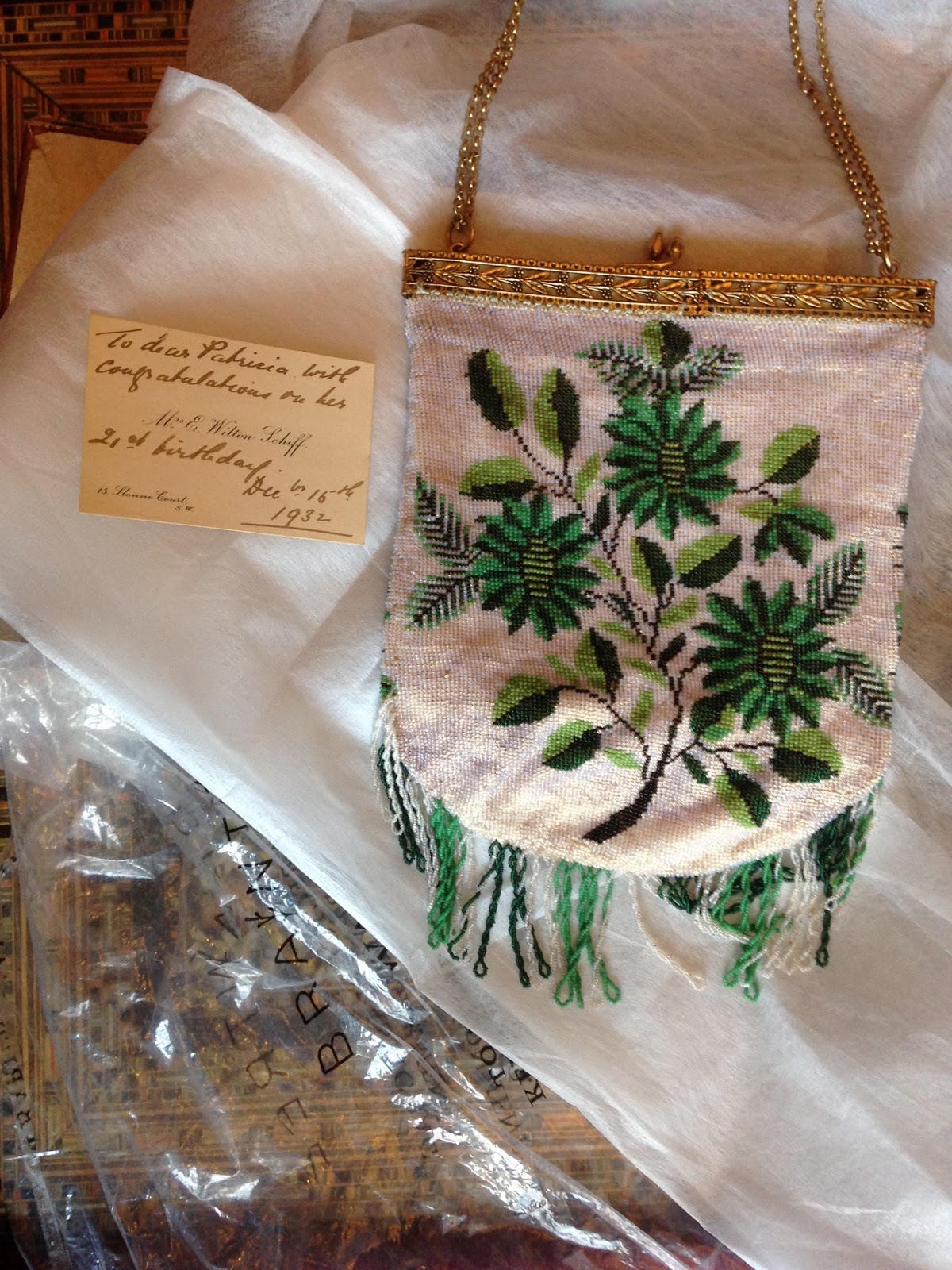
A Reticule


How were they made?Beadwork demanded needlecraft skill and the ability to devise and interpret patterns. At one end of the social spectrum, the pieceworker toiled over bags that were sent off to frame makers. At the other, privileged young ladies often presented their homemade bags as gifts or favours. Knitting with thin steel needles and crochet were the most popular methods of beading in the 19th and early 20th centuries. A modestly beaded bag could use as many as 100 bundles of beads (each bundle held 1,000 beads). Bag frames were available from ironmongers and drapers, and were carefully chosen to match the detailing of the bag.Along with being museum pieces, beaded bags are highly prized in collectors' circles where they command high prices. The greatly coveted beaded works were of such value that, in the early 1800s, the patterns used to make them were jealously guarded as family secrets passed down through generations.
1000 beads per inchBeaded bags from the middle of the 19th century were almost always made with very small, very fine beads -- up to 1000 beads/square inch can be found on bags dating before 1850. This type of fine beadwork produces a bag that appears tapestry-like.
'Indispensables'The earliest beaded bag was usually knitted in a drawstring style called a reticule, which also became known as an "indispensable" because it developed a universal popularity almost overnight. So popular was the reticule, it became an absolute "must" for fashionable ladies in 19th century Europe where the Empress Josephine, internationally known for her sense of fashion, carried a reticule with her at all times. Romantic figures, pastoral scenes, and flora and fauna became common themes rendered in the tiniest of beads.Dating the beaded bag poses a dilemma for textile historians, since newer bags are often made with older beads. For instance, beads from the early 1800s might be used to decorate bags made in the 1920s. And while a bag's frame can sometimes provide clues to its age, not even this is foolproof. Only that rarity, a beaded bag signed and dated by its maker, provides reliable proof ... that is, if you can find one.
Between 1820 and 1830, beaded bags supported by metal frames came into vogue. Coming primarily from France and Austria, the frames were made of everything from pinchbeck, an alloy of cooper and zinc made to look like gold, to tortoiseshell. Chains, often formed of decorative, ornate links, were attached to the frames.
THE EARLY RETICULEBeaded bags made during the early and middle of the 1800's were almost always knit with the very tiniest of beads, up to 1000 beads per square inch can be found on purses dating before 1850.  Certain bead colors can also help date an earlier purse such as cornflower blue and brick red.Beaded drawstring bags, called the reticule, also have distinct characteristics. Although there are exceptions, the basic early 1800's reticule is a knitted design of three horizontal parts.  The bottom could have been beaded in a star pattern with a beaded tassel hanging from the center of the rounded bottom.  Squared off purses sometimes had fringe instead of a tassel. The middle and usually largest section consisted of a floral or scenic motif.  The third and upper section might have a scalloped or floral border to compliment the design or perhaps a saw toothed edge, Greek key or other flattering pattern. The beaded bag would then be attached to a header, sometimes knit or crocheted,  also velvet or silk. Ribbon, cord or chain was drawn through the header and became the closure and handles of the reticule.Many beaded bags can be very hard to date because older beads were often used to create purses during the early 1900's.  Early 1900's bags were also patterned after the older 1800's designs and styles.  Even the purse frame does not always determine age because by 1900, beaded purses were so fashionable that the older reticules were regularly added to purse frames for a more up-to-date and desired look.  Some purse enthusiasts criticize the practice of adding an antique purse frame to an 1800's reticule, they even find it inexcusable and suggests that doing it may lower the value of the purse, but the fact is, this practice has been going on for over 100 years, the reason being, it is what the owner or buyer prefers.

Recently my cousin Mary-Lu Hick in nearby Barnstaple contacted me about a family heirloom that she had inherited from her mother. She kindly sent me photographs, and a few days ago she called in to visit me bringing it with her. I took more photographs and her and my photographs are above. This small beaded purse still has the card that came with it when it was given to her mother for her 21st birthday by Emma Wilton Schiff, widow of Ernest junior.
The card reads;
To dear Patricia with congratulations on her 21st birthday, Decr 15th 1932.This was one of Aunt Emma's treasures, left to me by her. It was worked by your grandfather's grandmother. It had a silk top, but I have mounted it in a frame to make it more serviceable and up to date!

Mrs E. Wilton Schiff15, Sloane Court, S. W.

Patricia's grandfather was Charles Schiff, and of course he had two grandmothers. His father's mother was Augusta Fuld, born in Mannheim in 1771. His mother's mother was Nechle Löwenthal, born in 1777 in Lissa, now Leszno in Poland. I shall guess that it may have belonged to her and that it has been passed down from her.

New Information about the early Schiffs: Samuel and his son Salomon

Journal für Fabrik, Manufaktur und Handlung, Volume 58

Voß und Leo, 1799


A chance search for Samuel Schwalbach produced this volume, part of the Google project to make available early printed books. It is a commercial directory printed in Leipzig in 1799 listing, I believe, tradesmen in German-speaking states. Here is the entry:
Mannheim: der Schutzjude Samuel Schwalbach.
This needs some explanation.
1. Samuel Schwalbach just over a decade later changed his name to Samuel Schiff.
2. He was born in Hanau. Hanau is 20km to the east of Frankfurt, about four hours by foot. Mannheim is 90km south-south-west of Hanau, and about nineteen hours journey by foot. Hanau was in the Landgraviate of Hesse-Kassel. Frankfurt was an Imperial Free City. Mannheim belonged to the Elector Palatine until 1802 when it was given to the Grand Duke of Baden.
3. Samuel Schwalbach is described as a schutzjude.
Schutzjude (German for "Protected Jew") was a status for German Jews granted by the imperial, princely or royal courts. 
"After the general expulsions of the Jews from a given territory often only single Jews — if any at all — would be granted the personal privilege to reside within the territory. This personal privilege, documented by a Schutzbrief (writ of protection), a Geleitsbrief (writ of escort), or (in Brandenburg) a Patent, was sometimes inheritable by only one son (in rare instances, by all sons), and was sometimes uninheritable. Jews holding such a privilege were thus called Schutzjudenvergeleitete Juden, or Patentjuden, as opposed to Jews who had no right of residence, who were known as unvergeleitete Juden. The latter were not allowed to marry, and might spend their life unmarried as a member of the household of a privileged relative or employer." (Wikipedia)
I believe that Samuel Schwalbach was a posthumous child but he appears to have been well provided for. He was married to Augusta Fuld of Heidelberg, who was also an orphan and who I suspect brought him a dowry. I imagine that he moved to Mannheim as a result of purchasing a permit that gave him the status of a schutzjude. I wonder if that was affected by the transfer of Mannheim to the Grand Duchy of Baden in 1802.

The eldest of Samuel's children was Leopold, born in 1797, ancestor of the London Schiff family. His youngest son was Samson, born in 1807, my own ancestor and of the Italian branch of the family. Adolph, born in 1801 and later a teacher in Nuremburg, appears not to have married or left descendants. There was a fourth son, Salomon, born in 1805, about whose life I have been gradually discovering details. We know that he married and had two sons: Rudolph, who left descendants to this day, and Friedrich Salomon, born posthumously—hence his carrying his father's name. I have traced nothing else about him.
We know that Salomon Schiff was a doctor, further indicating the rise in status of the Schiff family subsequent to the Napoleonic wars.


Verzeichniss der Lehrgegenstände des Großherzoglichen Lyceums in Mannheimals Einladung zu den öffentlichen Prüfungen am .... 1824/25


Here we have a Salomon Schwalbach from Mannheim as a student in the second year of the fifth class of the Grand Ducal Lyceum in Mannheim. I am perplexed by the use of the surname Schwalbach though at this late date. Also, Salomon was twenty years old by now.

Annalen für die gesammte heilkunde: unter der redaction der ..., Volumes 3-4

edited by Jakob Conrad Flachsland, Friedrich Wilhelm Maler


Although my German is inadequate, I believe that we see here that in fact Salomon was at medical school, and that he qualified as a doctor in 1832.