These are interlocking themes: how Sydney Schiff used his inherited wealth to help artists, how he was considered a Jew even though his mother was English, he himself identified as Anglican, and how the English establishment and society has been scathingly dismissive of him and his achievements over the past one hundred years in a way that is antisemitic.
Sydney Schiff had a difficult relationship with his father, an outrageously successful Jewish-born financier of Triestine origin, who at the same time separated himself completely from these roots. His expectation ws that his son would follow in his footsteps, but like his father he was a rebel, but in a very different way. Alfred Schiff was a rebel in his personal life, Sydney was a rebel in rejecting high finance and the Stock Exchange, and pursuing instead his love of the arts, both in painting and in literature. This decision was complicated by the relationship with his mother, which was particularly close. His early marriage to a grasping young American without his parents' consent alienated him permanently from his mother, and her early death was blamed on him, and further damaged his relationship with his father. However, it was his father's generous financial support that allowed him to pursue his dream, though this was very much delayed until the divorce from his first wife after twenty years of unhappiness, and was only to flower when he met his muse, his second wife, Violet Beddington.
In pictorial and plastic arts Sydney Schiff's web spread wide. A mere list of names associated with Sydney gives an initial indication. Here are some in random order: Mark Gertler, Henri Gaudier-Brzeska, Isaac Rosenberg, Wyndham Lewis, Pablo Picasso, John Currie, Stanley Spencer, William Roberts, Giorgio de Chirico, Jacob Epstein, Eric Gill, Filippo Marinetti, Duncan Grant, Richard Eurich. Some he personally supported and encouraged, some he owned works produced by. In the field of literature, as a published author himself, he was associated with Edwin Muir, T. S. Eliot, Wyndham Lewis, Isaac Rosenberg, Katherine Mansfield, John Middleton Murry, Marcel Proust, James Joyce, the Sitwells, Edith, Osbert and Sacheverell, Hermann Hesse,
[to be continued]
Saturday, 16 January 2016

Monday, 4 January 2016
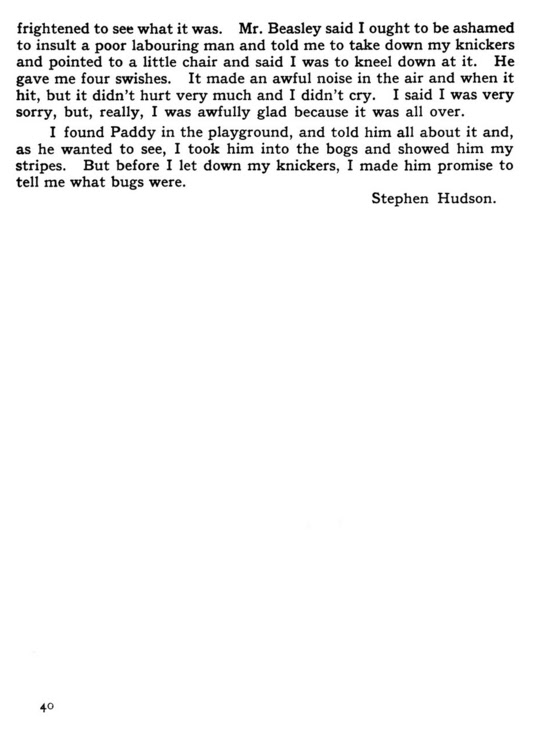
Bugs
This is a short story written by Stephen Hudson for the second issue of the magazine 'The Tyro', published in 1922, run by his friend and protégé Wyndham Lewis. It had a run of only two issues. The story is from his book 'Prince Hempseed', published in 1923. It is written from the viewpoint of the child. This extract appears in chapter six.




Saturday, 2 January 2016
War-Time Silhouettes: Mr Reiss's Final Grievance
Sydney Schiff's first published writing was 'War-Time Silhouettes' in 1916. It is a collection of seven short stories. The story with apparently the most autobiographical content is the first, 'Mr Reiss's Final Grievance', which is a character study of his uncle, Sir Ernest Schiff, and his dealings with his nephew, Percy, in real life Alfred Sydney Borlase Schiff, son of Ernest Wilton Schiff.
This was the first novel that Sydney Schiff published under his pseudonym of Stephen Hudson. This decision may have been because his uncle was still alive, and would have been offended if he had read this short story. He was not to die until November, 1918.
There is an additional sad irony: this short story was published in 1916. 'Percy' did not in fact die until the following year, on 9th April, 1917. This must have caused some anguish to Sydney Schiff. It is however possible that 'Percy' on this occasion referred to his cousin Martin Noel Schiff, who died on 17th June, 1916, but this seems unlikely. Elsewhere he is referred to as 'percy', and he was seen by Sir Ernest Schiff as his heir, by-passing his father Ernest Wilton Schiff.
This was the first novel that Sydney Schiff published under his pseudonym of Stephen Hudson. This decision may have been because his uncle was still alive, and would have been offended if he had read this short story. He was not to die until November, 1918.
There is an additional sad irony: this short story was published in 1916. 'Percy' did not in fact die until the following year, on 9th April, 1917. This must have caused some anguish to Sydney Schiff. It is however possible that 'Percy' on this occasion referred to his cousin Martin Noel Schiff, who died on 17th June, 1916, but this seems unlikely. Elsewhere he is referred to as 'percy', and he was seen by Sir Ernest Schiff as his heir, by-passing his father Ernest Wilton Schiff.
I. MR. REISS'S FINAL GRIEVANCE
Mr. Adolf Reiss, merchant, sits alone on
a gloomy December afternoon. He gazes into the fire with jaundiced eyes
reflecting on his grievance against Life. The room is furnished expensively but
arranged without taste, and it completely lacks home atmosphere. Mr. Reiss's
room is, like himself, uncomfortable. The walls are covered with pictures, but
their effect is unpleasing; perhaps this is because they were bought by him as
reputed bargains, sometimes at forced sales of bankrupt acquaintances.
Making and thinking about money has not
left Mr. Reiss time to consider comfort, but for Art, in the form of pictures
and other saleable commodities, he has a certain respect. Such things if bought
judiciously have been known to increase in value in the most extraordinary
manner, and as this generally happens long after their creators are dead, he
leaves living artists severely alone. The essence of successful speculation is
to limit your liability.
Mr. Reiss is a short, stoutish, ungainly
man past seventy, and he suffers from chronic indigestion. He is one of those
people of whom it is difficult to believe that they ever were young.
But it is not on account of these
disadvantages that Mr. Reiss considers himself ill treated by Fate. It is
because since the War he regards himself as a ruined man. Half his fortune
remains; but Mr. Reiss, though he hates the rich, despises the merely well-off.
Of a man whose income would generally be considered wealth he says, "Bah!
He hasn't a penny." Below this level every one is "a pauper";
now he rather envies such pitiable people because "they've got nothing to
lose." His philosophy of life is simple to grasp, and he can never
understand why so many people refuse to accept it. If they did, he thinks that
the world would not be such an unpleasant place to live in. Life in his opinion
is simply a fight for money. All the trouble in the world is caused by the want
of it, all the happiness man requires can be purchased with it. Those who think
the contrary are fools, and if they go to the length of professing indifference
to money they are "humbugs."
"Humbug" and "Bunkum"
are favourite words of his. He generally dismisses remarks and stops discussion
by the use of either or both. His solitary term of praise is the word
"respectable" and he uses it sparingly, being as far as he can
conscientiously go in approval of any one; he thus eulogizes those who live
within their means and have never been known to be hard up. People who are hard
up are "wasters." No one has any business to be hard up;
"respectable" men live on what they've got. If any one were to ask
him how people are to live within their means when they've not got any, he
would reply with the word "bunkum" and clinch the argument with a
grunt. It will be understood that conversation with Mr. Adolf Reiss is not
easy.
* * * * *
 |
| 'Percy': Alfred Sydney Borlase Schiff |
A knock on the door. Mr. Reiss's servant
announces some one and withdraws.
Intuitively Mr. Reiss, who is rather
deaf, and has not caught the name, grasps the paper and hides behind it. From
long experience he has discovered the utility of the newspaper as a sort of
parapet behind which he can better await attack.
A slight figure in khaki advances into
the room, observes the newspaper above the legs and smiles slightly.
"Hello, uncle!" It's a fresh
young voice.
Mr. Reiss grunts, slowly lowers the paper
and gazes at the youth over his eyeglasses.
"Oh, it's you. When did you come
up?"
"Just arrived, uncle. We're ordered
out. I thought I'd look you upat once as there are one or two things——"
"Eh——what?"
Among Mr. Reiss's characteristics is a
disconcerting habit of making people repeat their remarks. This is deliberate
and its purpose twofold——to gain time and to embarrass the person addressed.
The young fellow sits down rather
uncomfortably and begins again——
"We're ordered out, you know——"
"No, I didn't know. How could I? You
never write——"
Mr. Reiss consolidates his defence with
the pretence of a grievance.
"I didn't know myself until
yesterday. They don't give one much time, you know."
"They——who?"
"The War Office people. You see, our
first battalion has had a lot of casualties and three of us subs are being
taken from the third.
We've got to join the day after
to-morrow. Bit of a rush. And I've got things to get. I'm afraid I must ask you
to give me a leg up, uncle. I'm a bit short——"
"Short? Why, you've got an ample
allowance besides your pay and the Government pays for your outfit at an
extravagant rate." Mr. Reiss never ceases denouncing the extravagance of
the Government. He now adjusts his glasses and glowers at the youngster, who
fidgets under the scrutiny. "Yes, I know. I——" he stammers.
"Well——well?"
"The fact is——when Staples, our
captain, went back——he——I——"
A grunt. Then, "Eh——what?"
"He was engaged, you know."
"Well——well?" irritably.
"I can't explain, uncle, if you
don't give me a chance."
Another grunt.
"Jimmie——I mean Staples——wanted to
give his girl a ring before he went back. He hadn't enough money--so I lent him
fifty pounds."
Mr. Reiss drops his glasses, gets up from
his chair, and stands before the fire, facing his nephew.
"So you lent him fifty pounds, did
you? A third of your annual allowance. You had no business to——and if Captain
Whatever's-his-name were a respectable man, he would have saved the money to
pay for the ring.
Instead of that I have to pay for it."
"Oh no, uncle."
"How d'you mean——'no, uncle'? Aren't
you asking me for money? It's always the same story with the lot of you. You
like to be generous at other people's expense. I've told you I'm a ruined man.
The fortune which was the result of my hard work all my life has disappeared.
I'm a poor man. I spend nothing on myself. I've given up my car. I've put down
everything. I'm trying to dispose of my pictures and to sell the lease of this
place. You don't seem to understand what this infernal war means to people like
myself. You don't have to pay for it.
Do you realize that one-third of my
entire income goes for income tax? I've paid your bills over and over again,
but I can't do it any more. For this once I'll——" The boy holds up his
hand.
"Look here, uncle. I'd better tell
you at once. I shall need another fifty to make me square. But I'll pay you
back——on my honour——"
"Bah! Your honour! Pay me back. I
know what that means. So it's a hundred pounds you want. Very well. You shall
have your hundred pounds. But I solemnly warn you that it's the last penny I
intend to pay for your extravagance. As for that waster of a Captain
What's-his——"
The boy flushes to the roots of his
light, wavy hair.
"I say, uncle. He's not a waster.
He's the finest fellow in the regiment. I can't allow you——Look here——never
mind the money. The jeweller knows it's all right. I'd rather——"
He stops. The words won't come. He gazes
at his uncle helplessly. Mr. Reiss goes slowly to the writing-table and sits
down. Taking a blank cheque from a pocket-book he always carries, he fills it
in and passes it to the boy without speaking.
"I don't like taking it, uncle. I
don't, really——" Mr. Reiss half turns round. He still says nothing, he
does not even grunt. He knows that there are times when silence is golden.
Moreover, he knows that money talks.
A few minutes later Mr. Adolf Reiss is
again sitting alone, gazing into the fire. And he has another grievance against
Life.
* * * * *
The philosophy of Mr. Reiss is a natural
result of his early environment. In Magdeburg, where he was born and brought
up, education in business principles is combined with the theory of family
duty. Whether this theory takes the place of affection or not, its application
in the case of Mr. Reiss resulted in his migration at an early age to England, where
he soon found a market for his German industry, his German thriftiness, and his
German astuteness. He established a business and took out naturalization
papers. Until the War came Mr. Reiss was growing richer and richer. His talent
for saving kept pace with his gift for making.
He spent evening after evening, when he
came home from the City, thinking out different ways of tying up his fortune on
Percy, so that it could remain intact as long as possible. Some of his schemes for
insuring the safety of his capital, for the resettlement of the greater part of
the income by trustees——for combining, in fact, a maximum of growing power for
the fortune with a minimum of enjoyment for the heir——were really marvels of
ingenuity.
But since the War his thoughts have taken
a different turn. Half his fortune has gone. He is too old now to catch up
again. It's all over with money-making. The most he can hope for is to keep
"the little
that is left." If only Percy had
been older and had a son, he could settle the money upon his great-nephew. Then
there would have been time for the money to accumulate again.
And now he's gone to the Front. He might
be killed. It doesn't bear thinking about. He has toiled all his life. Surely
after all his self-sacrifice and
self-denial he is not to be robbed of the one satisfaction he asks for, to know
that the beggarly remains of his wealth shall be safe after his own death.
Every day he scans the papers anxiously.
His one preoccupation is the daily casualty list.
* * * * *
Spring is at hand, and though there is
chill in the air Mr. Reiss is economical and sits before an empty grate.
Self-mortification always seems to him to be evidence of moral superiority and
to confirm his right to special grievances. He is reading a letter over again
received that morning from Percy. It bears the stamp of the Base Censor and is
some days old.
DEAR UNCLE ADOLF,
You remember my friend Jimmy Staples——the
one I told you about, who was engaged and I lent that money to? Well, he's been
killed, or rather he has just died of wounds. He has done splendidly. Our
Brigadier had sent in his name for a V.C. I'll tell you all about it when I see
you. But what I wanted to say is that it's all right about the money. I've got
lots in the bank now, and in another couple of months I shall be able to pay
you back. One can't spend anything much out here. I'm quite fit, but I'm rather
in the blues about Jimmy. Mother will give you all my news.
Your affectionate Nephew.
P.S.——By the way, I gave your name as
nearest relative in case of accidents, to save mother.
Mr. Reiss has a curious and unaccustomed
feeling of flatness as he re-reads the letter. Somehow or other he does not
want Percy to pay him back that fifty pounds. He thinks he'll write and tell
him so at
once.
He sits down at the writing-table——the
same one at which he had written the cheque the last time he saw Percy. The
scene comes back to him with a strange vividness as he dips his pen in the ink.
He hesitates a moment before beginning the letter. Was there anything he could
say that would please Percy? He has a curious and at the same time a strong
desire to do something now——at once. He has never felt like this before.
Supposing he were to——A knock on the door. His servant brings in a telegram.
Why do Mr. Reiss's fingers tremble so? Why does Mr. Reiss begin cleaning his
glasses before he opens the envelope?
He holds the pink paper under the lamp.
Deeply regret to inform you....
Mr. Adolf Reiss does not need to read
farther, and now he has a final grievance against Life.
Friday, 1 January 2016
The Other Side
Sydney Schiff's final book was "The Other Side", published in 1937, and dedicated "To S. S. Koteliansky". Curiously, although Schiff had been a good friend and supporter of Koteliansky in the early 1920s, in 1926 Koteliansky turned on Schiff in a similar manner to Wyndham Lewis, and the friendship suffered in consequences. This may have been an attempt by Sydney Schiff to mend the relationship.
The book covers the period of Sydney Schiff's American adventure in the 1880s. He went to Alberta, Canada, in 1887, before joining his uncle Charles in Cincinnati. He married in haste in 1889, and returned with his wife to England in 1890.
The book starts with his voyage across the Atlantic...
I have just discovered that 'The Other Side' is included in later editions of 'A True Story'. I have three editions:
1. 1933 reprint by "Crown Constable" of the 1930 edition. This does not include 'The Other Side'.
2. 1948 edition by The Falcon Press, with the statement: "A True Story was first published in 1930 and comprised three novels and part of a fourth, all of which had appeared separately under different titles. These were published in French by Gallimard in 1935, 1936 and 1938 respectively.
The present new edition, revised by the author in 1944, includes a fifth volume which was published in 1937, and an epilogue that has not previously been published."
3. 1958/1965 published by Dent and Sons in London, and Dutton & Co in New York in 1965. This appears to be the same as the 1948 edition, but I should suspect that it was edited by Violet Schiff.
The book covers the period of Sydney Schiff's American adventure in the 1880s. He went to Alberta, Canada, in 1887, before joining his uncle Charles in Cincinnati. He married in haste in 1889, and returned with his wife to England in 1890.
The book starts with his voyage across the Atlantic...
I have just discovered that 'The Other Side' is included in later editions of 'A True Story'. I have three editions:
1. 1933 reprint by "Crown Constable" of the 1930 edition. This does not include 'The Other Side'.
2. 1948 edition by The Falcon Press, with the statement: "A True Story was first published in 1930 and comprised three novels and part of a fourth, all of which had appeared separately under different titles. These were published in French by Gallimard in 1935, 1936 and 1938 respectively.
The present new edition, revised by the author in 1944, includes a fifth volume which was published in 1937, and an epilogue that has not previously been published."
3. 1958/1965 published by Dent and Sons in London, and Dutton & Co in New York in 1965. This appears to be the same as the 1948 edition, but I should suspect that it was edited by Violet Schiff.
'Myrtle'
Published in 1925 by Sydney Schiff, writing under his nom de plume Stephen Hudson, 'Myrtle', dedicated 'To my friend Frederick Delius', whom Sydney Schiff had befriended at some time before March, 1920. It follows a format of nine chapters:
1. Nanny
This is written as though from the viewpoint of a working class woman in the employ of Mr and Mrs Vendramin — alias Mr and Mrs Beddington, parents of Violet Schiff, his wife. It is a story from the Beddington family of Violet's youth that she must have told him. There is a reference to her sister Evelyn's marriage to Walter Behrens ["Mr Hildebrand Moreton"] of Paris.
2. Jane Grey
This is another tale of the Beddington family, with an account of the character of Violet's ["Myrtle"] father, of her sisters, and the death of her brother.
3. Sylvia
The story of Violet's sister's unhappy marriage, her husband's affair, her own affair with an artist, the attempt at reconciliation and his consequent suicide.
4. Adrian
More stories of the Vendramins, with mentions of the suicide, and of Sir Michael O'Halloran {Sir Arthur Sullivan] and his proposal to 'Myrtle". The death of Sydney's mother in 1896 is mentioned, their home in Nice, his father's trip to Egypt with Sydney's sisters. There is the developing romance between Sydney and Violet. I surmise that 'Adrian' may in fact be Sydney Schiff — or is it Max? Sydney's brother Ernest — alias 'Tony' — appears, with a reference to his liaison with the famous courtesan Liane de Pougy. There is a Cécile, who I guess may be Sydney's mistress, referred to elsewhere in his fiction as Marguérite.
5. Marcel
This starts with a quote from T.S. Eliot's "Prufrock" i.e. "The Love Song of J. Alfred Prufrock", published in 1920. Sydney and Violet Schiff had become friends in 1919 with the Eliots, and even took them on holiday that year. Sydney had written to Eliot about the poem, carefully analysing it. The title is presumably a reference to Marcel Proust: Sydney's wife Violet had introduced him to Proust's first book "Du Côté de Chez Swann" in 1916, and he had devoured it, and was inspired tremendously by it, so that he attempted to become an English Proust. Sydney Schiff's first book, "War Time Silhouettes', was published in 1916.
6. Sir Michael O'Halloran
This is the account of Sir Arthur Sullivan's proposal to Violet Beddington written as though from his viewpoint.
7. Basil Moriarty
This appears to be an account of a previous amour of Violet beddington.
8. Block
Miss Vendramin, Moriarty, Marcel and Evangeline, a performance of "Delilah", Paris, a closing letter in French... I didn't get this story.
9. Kurt
This is an essay that Sydney Schiff included in his omnibus edition of The Kurt Saga as a postscript. It concerns his uncle, Charles Schiff, "Theo", and his American wife Mary Burch, "Aunt Kate". Then follows an account of the early days of his romance with "Myrtle": Violet Beddington. He details his personal love life over twenty years, ending with the decision to part.
The book ends with an essay by Edwin Muir, Sydney Schiff's friend, entitled "The Art of Stephen Hudson", originally printed in the "New York Evening Post". It deals mostly with the novel "Tony", published in 1924. Another essay on the same subject was published by Edwin Muir the following year in his book "Transition".
1. Nanny
This is written as though from the viewpoint of a working class woman in the employ of Mr and Mrs Vendramin — alias Mr and Mrs Beddington, parents of Violet Schiff, his wife. It is a story from the Beddington family of Violet's youth that she must have told him. There is a reference to her sister Evelyn's marriage to Walter Behrens ["Mr Hildebrand Moreton"] of Paris.
2. Jane Grey
This is another tale of the Beddington family, with an account of the character of Violet's ["Myrtle"] father, of her sisters, and the death of her brother.
3. Sylvia
The story of Violet's sister's unhappy marriage, her husband's affair, her own affair with an artist, the attempt at reconciliation and his consequent suicide.
4. Adrian
More stories of the Vendramins, with mentions of the suicide, and of Sir Michael O'Halloran {Sir Arthur Sullivan] and his proposal to 'Myrtle". The death of Sydney's mother in 1896 is mentioned, their home in Nice, his father's trip to Egypt with Sydney's sisters. There is the developing romance between Sydney and Violet. I surmise that 'Adrian' may in fact be Sydney Schiff — or is it Max? Sydney's brother Ernest — alias 'Tony' — appears, with a reference to his liaison with the famous courtesan Liane de Pougy. There is a Cécile, who I guess may be Sydney's mistress, referred to elsewhere in his fiction as Marguérite.
5. Marcel
This starts with a quote from T.S. Eliot's "Prufrock" i.e. "The Love Song of J. Alfred Prufrock", published in 1920. Sydney and Violet Schiff had become friends in 1919 with the Eliots, and even took them on holiday that year. Sydney had written to Eliot about the poem, carefully analysing it. The title is presumably a reference to Marcel Proust: Sydney's wife Violet had introduced him to Proust's first book "Du Côté de Chez Swann" in 1916, and he had devoured it, and was inspired tremendously by it, so that he attempted to become an English Proust. Sydney Schiff's first book, "War Time Silhouettes', was published in 1916.
6. Sir Michael O'Halloran
This is the account of Sir Arthur Sullivan's proposal to Violet Beddington written as though from his viewpoint.
7. Basil Moriarty
This appears to be an account of a previous amour of Violet beddington.
8. Block
Miss Vendramin, Moriarty, Marcel and Evangeline, a performance of "Delilah", Paris, a closing letter in French... I didn't get this story.
9. Kurt
This is an essay that Sydney Schiff included in his omnibus edition of The Kurt Saga as a postscript. It concerns his uncle, Charles Schiff, "Theo", and his American wife Mary Burch, "Aunt Kate". Then follows an account of the early days of his romance with "Myrtle": Violet Beddington. He details his personal love life over twenty years, ending with the decision to part.
The book ends with an essay by Edwin Muir, Sydney Schiff's friend, entitled "The Art of Stephen Hudson", originally printed in the "New York Evening Post". It deals mostly with the novel "Tony", published in 1924. Another essay on the same subject was published by Edwin Muir the following year in his book "Transition".
Thursday, 24 December 2015
Richard, Myrtle and I: a Novel by Sydney Schiff
Richard, Myrtle and I
This is a late work by Sydney Schiff, writing as Stephen Hudson. Like much of his work it is autobiographical. It appeared in 1926, a year after his book ‘Myrtle’.
It is a strange book, which I found confusing and difficult to follow. I would guess, as he himself hints, that he had been reading Freud, and was familiar now with the concepts of id, ego and superego, and in consequence the ‘hero’ of the novel, Richard, appears as two personae. This is never made clear, so that the ‘I’ of the title is a strange concept: an almost invisible éminence grise or bad angel, who makes comments and appears and vanishes. The book was not included in the omnibus version of the Richard Kurt series, neither was ‘Tony’, which also forsook a narrative style in the third person, and adopted the first person, which became impossible to sustain successfully with the death of the narrator.
There are, however, several passages in the book that are of interest for the insights they give to Sydney Schiff’s life and character.

The copy in my possession formerly belonged to Sydney Schiff’s younger sister, Baroness Marie de Marwicz, and bears her bookplate. She must have been very familiar with her brother’s life in all its details, and I wonder if she read the book and what she made of it.
There is an interesting glimpse of the Schiff family at the very beginning of the book, on page 8.
“I knew all the members of the Kurt family, who, with the exception of Richard’s brother, Anthony, all avoided me. This did not prevent my having a certain respect for Richard’s mother and for his uncle Frederick. These two had strength of will and unflinching courage, qualities that appeal to me even if misdirected. When Mrs. Kurt died I was still young but I remember words of hers which showed that she felt the growth of a spirit in me that must in the end assert itself. In Frederick Kurt I recognised one from whom I must conceal my strength, for he, unlike Richard, would have crushed it before it had time to develop. Anthony was another matter. It amused him and suited his temperament to encourage my emergence and to provoke my outbursts. He had not the kind of intelligence to grasp my character, still less to anticipate the results of my conflicts with his brother. It sufficed him, if for the time being, Richard was placed in an uncomfortable or false position by my attitude and behaviour, the significance of which he desired as little to understand as I to explain it.”
Richard is Sydney Schiff, Frederick is his uncle Ernest Schiff, and Anthony is his brother Ernest Wilton Schiff.
On page 22 is a quite harsh description of the relation ship between Sydney Schiff and his wife Marion Fulton Canine.
“Richard had been married to his first wife Elinor for over twelve years before i caught my first glimpse of her. That glimpse was enough. If his character is an open book to me, Elinor’s was a sheet of glass. Only Richard could have got entangled with so obvious, so uninteresting a personality, only Richard could have endured the society of an acrid and detestable human clothes-horse for nearly twenty years…” He follows this with an example of her behaviour.
 |
| Sir Edward Beddington-Behrens |
On page 46 is an account of the death of his wife, Violet Schiff’s, sister in Paris, leaving twin boys. One was to die in the Great War, the other was to become Sir Edward Beddington-Behrens.
 |
| Villa Valscura, Blevio, Lake Como |
Page 5a has a reference to Schiff’s villa on Lake Como. On page 76 is an interesting family reference:
“My uncle wants us to join him in Hamburg. My two old aunts are keen on seeing Myrtle.” Sydney Schiff’s uncle, Sir Ernest Schiff, had in fact originally three aunts in Hamburg. The eldest Emma was married to a Dr Lazarus, and she was joined by her unmarried sisters from Trieste, Jenny and Virginia.
There is a curious and atmospheric passage about the Schiff family on page 78:
“I am in a large square room that seems in a manner familiar to me. With their backs to me, Richard, Myrtle and three other figures are gazing at two pictures, masterly and vital portraits of a middle-aged man and a middle-aged woman, amazingly strong and resilient personalities, dressed in the fashion of the end of the eighteenth century. Off the three figures, one, a man of short square build, is muttering. he doesn’t turn. He is absorbed in the portraits.
“Thou Nathaniel! Thou Johanna! Look down upon us. Theophilus, William, married among strangers. Now they are gone. Both begat sons but the old stock is dying out, dying out. They cannot make, they cannot hold. Richard, weaker son of a weak father, has no issue; Anthony, a wastrel, what can his boy become? Theo’s two boys are not of us. Their mother’s God is not our God, her people are not our people. We are dying out.’
It was Frederick Kurt who turned and, without speaking, looking downwards, walked slowly across the room. I caught his grim, firm profile, the thin shaven lips, the ‘trifle of whisker,’ the air of ‘self-confidence and self-esteem,’ and, over all, the shadow of the past, the shadow of death…”
Nathaniel was Leopold Schiff, husband of Johanna Wollheim. Theophilus is their elder son Charles, William is Alfred, Richard is his son Sydney, and Anthony his younger son. Frederick of course is Sir Ernest Schiff. Anthony had one son who died in the great war. Charles had two sons, one of whom died also in the Great War, and the other adopted his mother’s surname of Burch.
Quite different to these references to family is the description on page 116 of Richard’s, or in other words Sydney Schiff’s, interest and involvement in modern art.
“Richard’s excursions into the field of plastic and pictorial Art began to assume significance for me after we paid a visit to each in turn of the two young artists whose acquaintance we made on the occasion the sculptor’s expulsion provided the evening’s entertainment. They had been students of the same Art school and had doubtless been united during that period of adolescence by a common hatred of their colleagues. But it was soon apparent that the diversity of their proletarian origins, the one was a Galician Jew, the other a Connemara Kelt, made the pair of aliens temperamentally incompatible. The young Jew’s favourite model was his mother, the young irishman’s his mistress…”
Is this Mark Gertler? Or Jacob Epstein?
 |
| Marcel Proust |
Proust appears on page 211. Sydney Schiff was an early advocate of Proust, and became his friend. Schiff adored proust, seeing him as the personification of what he himself would have liked to have been, even recognising Proust’s character Baron Charles as himself, in some ways.
“ ‘…I can’t even get him to read Proust.’
‘Who is Proust?’ I asked.
‘Proust is my newest and best friend, the only friend the war has brought me.’”
Later on page 217 he comments:
“…It was difficult to believe that any pure-bred Frenchman could have evolved a style so exotic and anti classical, still more that he would have selected a typical cosmopolitan jew as one of the principal personages of a novel in which all the social values of pre-war France are reviewed and assessed. These peculiarities struck me as extremely significant, the more so because they coincided with my own theory of the social and intellectual influences at work in modern Europe.”
Of course, both Proust and Schiff had a Jewish parent. Proust inspired Schiff’s writing and affected the way he wrote.
 |
| Denis Saurat |
The book ends with a postscript, ‘A Note on Stephen Hudson’, by Denis Saurat.
“After receiving a doctorate of the University of Bordeaux, and a lauréat des concours d'agrégation in 1919, he became associated with the Department of French at King's College London from 1920, where he was a professor from 1926. He was also director for many years of the French Institute of London (Institut Français) in South Kensington.” [Wikipedia]
This short essay stresses the importance of a female muse for a writer, and also the Freudian concepts of the ego and the superego ‘in the psychology of the artist himself.’
Tuesday, 22 December 2015
Silvio Schiff
 |
| Silvio Schiff as a young man |
 |
| Emilia Finzi, wife of Silvio Schiff |

Silvio was married to Emilia Finzi, daughter of Constantino Finzi and his wife Emma Teglio. I believe Constantino Finzi was a coffee wholesaler, born in Ferrara, but whose business was in Genova, home of his wife and her family. I do not know the date of Silvio's marriage, but their son, my grandfather Giulio, was born on 14th August, 1904.
 |
| Emilia convalescing |
 |
| Emilia with her son, and only child, my grandfather Giulio Cesare |
Emilia died of consumption on 14th November 1911, when my grandfather was just seven years old. It was following this that Silvio moved with his son to Salò, for an unknown reason, and it was my grandfather's primary schoolteacher, Giulia Grana, who became Silvio's second wife, bearing him four children. The eldest, the patriotically named Italia, was born in Salò in 12th December 1915. She was followed by Umberto in 1917, Albino in 1920, and Gino in 1926.
 |
| Silvio Schiff |
When I visited my grandfather at Peschiera in the summer of 1970 he kindly allowed me to photograph the images that are displayed here. A couple of tiny snapshots showed Silvio and Emilia with an early motor car.
 |
| Silvio Schiff and Emilia; probably in the Royal Park at Monza |
 |
| Emilia with her younger sister Elsa |
I always imagined that these were posed photographs, possibly with a hired car, but I have just discovered that I am wrong. Throughout 1907 a series of advertisements were placed in the sports supplement of the Turin newspaper 'La Stampa' which show that Silvio was not only qualified as an engineer, but that he was the agent for Italy for a firm of French car manufacturers.


My great grandfather somehow survived the war as a Jew in Salò, dying there in about 1948, not long after he had held his first great granddaughter, my elder sister Valerie, who was born in 1946.
 |
| Silvio Schiff in later life |
 |
| Silvio Schiff in old age |
Subscribe to:
Posts (Atom)