Saturday, 20 June 2015

Alfred George Schiff

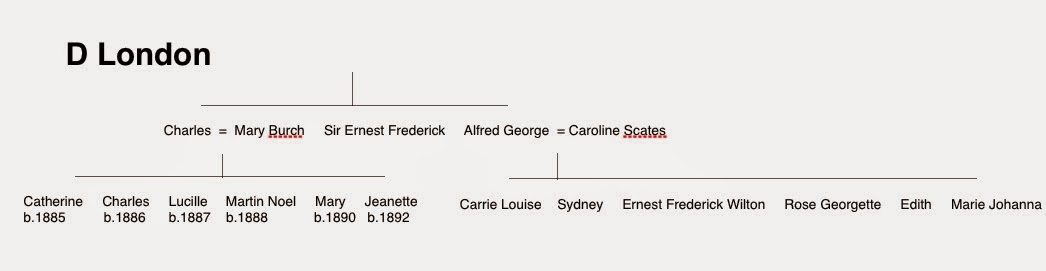
Alfred George Schiff was born in Trieste on 11th November, 1839, the third child and second son of Leopold and Johanna Schiff. He was only one year younger than Charles. His birth record in Mannheim gives his Italian forename as Alfredo and his Hebrew names as Arie Natan. His younger brother Ernest was born a year later. We know that he was educated at the University of Heidelberg, where he was a student of the famous Robert Wilhelm Bunsen. He first appears in London in the early 1860s, where he set up as a member of the Stock Exchange. He was also soon involved in a scandalous affair with a married woman who eventually became his wife: Caroline Mary Anne Eliza Cavell, née Scaites.
Her first child, who was probably fathered by Alfred, though this was not believed to be so by others, was Carrie Louise, born in 1865. Her second child, and definitely Ernest's son, was Sidney Alfred, born according to family tradition on 11th December, 1868. After Alfred's marriage on 14th August, 1869 his son Ernest Frederick Wilton Was born in 1870, and then three daughters: Edith Emma in 1871, Rose Georgette in 1874, and Marie Johanna in 1877. It was after Ernest's birth in 1870 that he applied for and received British nationality.

Alfred had a very successful career on the Stock Exchange and when he died in 1908 he was immensely wealthy. He was, however, tremendously disappointed by his sons, who did not follow him in his zeal for business and success.

Saturday, 23 May 2015

Marie Johanna Schiff


The youngest daughter of Alfred Schiff was born in 1877. She was presumably named Johanna after her paternal grandmother Johanna Wollheim. I have found nothing about her early life, but in July 1897 she married Hermann Richard Wächter of Hamburg in a suspiciously quiet ceremony at St George's, Hanover Square. There was a son born to this marriage, George Ernest Richard Harry Wächter; presumably George after his paternal grandfather, Ernest after his maternal great uncle and uncle, and Richard after his father. The marriage appears to have been short lived, and ended at some time in divorce, as by 1905 in her father Alfred Schiff's will, Marie is described as being the wife of Friedrich - or Fritz - von der Marwitz, and her first husband is obviously seriously out of favour, so much so that if young George Wächter were to live with his father then he would not receive any inheritance from his grandfather. I do not know what became of George's father, though he may possibly be the German soldier Hermann Wächter who died during the First World War on 18th December, 1914, on active service in the German army. As for George, he appears not to have married and died on 19th July, 1945 at Beaulieu-sur-Mer in the south of France, between Nice and Monaco.
[Postscript September 2018: George it seems did indeed marry, to the Brazilian Plàcida Martins. Soon after George's death she married Alvaro Lyra Da Silva of Rio de Janeiro by whom she had a daughter.]


Marie appears to have married Baron Friedrich Wilhelm Edmund von der Marwitz, a member of a well known and distinguished German noble and military family from Prussia, at some date prior to 1906. Their son, and probably only child, was Friedrich Alfred von der Marwitz, born at Frankfurt am Main, on 11th November, 1907. His names were presumably after his father, and maternal grandfather. Marie and her husband, the baron and baroness, appear to have settled at some time in England, where Marie eventually after the First World War reclaimed her British nationality and her husband was naturalised. Their surname was transformed to de Marwicz, giving it a Franco-Polish flavour, and indeed they seem to have lived a great deal in France, in Paris and Monte Carlo. Friedrich - now Frederick - wrote books in the 1920s heavily critical of Germany's role in the Great War. He died in Monte Carlo on 16th April, 1944, before the Second World War ended, and just over a year before the death of his stepson. Marie Johanna did not long outlive him: she died in England on 25th February 1948. 
[Postscript January, 2017: Marie divorced her husband and reclaimed her British nationality in order to receive her generous inheritance from her uncle Sir Ernest Schiff. She then promptly remarried her ex-husband.]


Frederick Alfred de Marwicz appears to have been educated in England, was also naturalised as British, and attended Pembroke College, Cambridge. He is known as an ice hockey player, also known as Frank or Bibo, and played for Great Britain as a left wing from 1930 to 1934. He served in the Second World War in the Scots Guards, rising to the rank of Captain. He was the third husband of Diana, born Frances Walkington, daughter of Thomas Walkington and Edith Mary Faulkner. She was born in Yorkshire in 1913. Her first husband was the Scot Anthony Gilbert Thorburn in 1935. In 1941 she married David Behar, whose name suggests he was a member of a Sephardi family, and in 1951 she married Frederick de Marwicz. Two daughters were born, Marie in 1952, who I believe lives in west London, and Diana in 1953, who I believe lives in Torbay. Frederick died in 1990.


Friday, 22 May 2015

A Miscarriage of Justice?


A week ago I was in Cornwall. On the Sunday afternoon we went to Lelant churchyard, close to St Ives, and searched for the grave of Ernest Wilton Schiff, but failed. We did enjoy eating our lunch on a bench in the churchyard, and the wonderful view across to the sea.


The next day we came back, and this time I found the grave within a couple of minutes. I don't think any member of the family has visited the grave since he was buried here ninety-six years ago, and I did recite kaddish for him and place a stone.


The grave at Lelant of Ernest WIlton Schiff

The inscription on the grave


Ernest was only forty-eight years ago when he died from the injuries he received from Albert John Nicholls, the Cornish miner who attacked him brutally accusing him of attempting to seduce his daughter. I have written about the coroner's enquiry and the trial already, but this visit prompted me to enquiry further. What I discovered was startling, and I feel that his death was undeserved and his attacker's acquittal unjust, unfair and inappropriate. It is difficult to write about the case in full detail as there are living descendants to both parties involved in the fight, but Ernest Wilton Schiff, for all his many faults, was definitely not the rogue he was painted by the gutter press of the time, whose outrageous statements have been repeated in recent publications.
Albert John Nicholls as a young man, with his daughters


Albert John Nicholls in later life


Bessie Chappell, wife of Albert John Nicholls and mother of Nora


Albert John Nicholls seems to have had a troubled life. When he was eleven he is described as 'adopted'. He did have a  criminal record, being fined for swearing, for example, in July 1900 and March 1907. He married his wife Bessie Chappell in the autumn of 1901. I presume he was Nora Kathleen's father, but it has proved impossible to even find her birth certificate. She is not mentioned of course in the 1901 census. In 1911 she is described as living with her mother's aunts and aged nine. Nora's subsequent story is hardly uplifting. She left Cornwall and took up with a much older man who already had a family of six children, being married to a Beatrice from Sancreed, and had six children by him, marrying him after two children had already been born. Their relationship was stormy and even was reported in the newspapers in 1933. Nora herself served a six months' sentence for running a brothel. One of her sons has bravely described her as 'exceedingly promiscuous'. After her husband's death in 1955 she subsequently remarried in 1956 to a Reginald Parsons, but in fact she too died relatively young, in June, 1962. Her death certificate states she was aged 59. Her own father did not long outlive his victim, dying in 1926 at the age of forty seven. 
Nora Kathleen Nicholls


As for Albert Nicholls and his brutal attack on Ernest Wilton Schiff, there are some unexplained problems with the case. The letter that was supposed to be the evidence of his daughter being enticed to become a London prostitute was never produced. The claim that Ernest Schiff's massive injuries were the result of a fall was never challenged, though it seems that Albert Nicholls kicked him repeatedly while he lay on the ground.

Strangely Nora and Ernest did share something. They were both very promiscuous, though he was largely protected by his class and wealth, except in Cornwall, where his London ways and German surname counted against him. In Cornwall he was grieving with the recent death of his only son in the Great War, and coming to terms with his recent divorce. He was in fact living with his mistress Selina Moxon, and it seems unlikely that he was able to seduce her, given her presence, and the smallness of the Tinners' Arms at Zennor, where they got to know each other over a period of several months in 1918 and 1919. Both his descendants and Nora's have had to carry the burden of this unhappy episode, though in different ways.

Friday, 24 April 2015

My Thoughts on Dasa Drndic, Author of 'Trieste'

I think I have already recounted the experience of buying the book 'Trieste' because of its title, and then my shock on discovering that it was based very much on my mother's account of her wartime experiences, at least for its first third, and how I contacted the publishers, having failed in my attempts to make friendly contact with the author, and how I actually met the author face to face during Jewish Book Week in London only to be met by silence and a refusal even to say hello or acknowledge me. Since then the author has continued an unpleasant small campaign of self-justification, and of belittlement of my mother's account of her childhood wartime experiences. With the launch of the Italian translation of the book two months ago the author has continued to do this, in interviews referring to my mother's account as 'pathetic, melodramatic and self-pitying.'

My mother's story is widely available on the internet and always has been since I placed it there. [http://gent.org.uk/italy/index.htmlIt is a simple, brief account, written, as I pointed out in my introduction, to inform my nieces, her granddaughters, as to the Jewish origins of my mother's family. It was never intended for a wider audience, but I decided to make it available, having already discovered how valuable was the internet in making it possible to make connections and discover links. I never thought my own mother's experiences were exceptional, but certainly they were interesting and individual. Thanks to the internet it was discovered by a Croatian author who was sufficiently inspired by it to create a 'documentary novel' that has outgrown its original, tiny, Croatian public to be translated into many languages and has reached a worldwide audience. I am not aware of other, similar first-hand accounts, but my mother's story was discovered, via the internet, by others, including Lucia Vincenti of the University of Palermo, who interviewed my mother during a brief visit to Sicily, and she made use of my mother's experiences in her books, such as 'Donne Ebree in Sicilia durante il Fascismo', on the back cover of which is a photograph of my mother taken at the end of the war when she was sixteen, and her book 'Storia degli Ebrei a Palermo durante il Fascismo'. My mother's story was also used, with permission, in the book 'War's Long Shadow', consisting of extracts of letters, diaries and other testimonies of many people who lived through the Second World War. All these books, of course, unlike 'Trieste', gave due, appropriate and courteous credit to my mother and to her brief account of her wartime experiences.

It was not just my mother's experience of anti-Jewish race laws and persecution that drew interest from others. There was also her account of life in Albania for the occupying Italian expatriate community in the period from 1939 to 1943, the time of the Italian surrender to the Allies. It seems that my publication of this account was possibly the first time that such experiences had been recorded and publicised, and led consequently to my being contacted by an Italian researcher, and also by an Italian who had shared those experiences in Albania seventy years ago, and both of those people spoke to my mother. The role of Italian Fascism in the Holocaust, together with the role of Fascist Italy as the invader of countries such as Albania, as well as Greece and Ethiopia, were themes that were shrouded in silence in the post-war years, associated as they were with a time when Italy was led astray by Mussolini and his ideas.

My reactions to the publication of the book 'Trieste', despite my initial shock, we're mostly good. I was indeed shocked, traumatised even to the point of bursting into tears as I opened the volume and saw my own family tree, with the names of my own ancestors. However, I was flattered. That an author had been inspired to take that simple story and use it as the vehicle for her own creation felt good. As I turned the first one hundred and twenty pages and found on almost every page a direct quote from the modest booklet produced by myself with my mother I was touched by its amplification and the effectiveness with which the narrative thread was made more satisfying. When my mother wrote her account in response to my many promptings I was delighted, though I remember my father's slight disappointment that it wasn't longer, that it was so elliptical, but my mother of course is not a professional writer or academic, she was and is an elderly housewife who, because of the Second World War, was mostly deprived of the education she merited and deserved. In addition, she was recording her memories and impressions through the eyes of an adolescent girl: she was twelve when she fled with her family from Sicily to Albania, fifteen when she fled again, from Albania to Gorizia, seventeen when, in Milan, she met my soldier father, and the same year became a bride and mother. There were no accounts of the experiences of Italian Jews during the Second World War available in Italian or English until twenty years ago. As for the Italian occupation of Albania there is probably next to nothing available even now.

What of the book 'Trieste' by Dasa Drndic itself? First of all I am a historian and not a novelist. I have written and published some books and articles whilst working in my own career. When I read a book like 'Trieste' I read it with my own viewpoint, attitudes and prejudices. Of course I found the first third, based on my mother's story, the most enjoyable and the most interesting. It is human, it is personal, it is to me, and no doubt to many readers, the easiest section to read. After that the book becomes hard work: it feels like a cut and paste job from archive material: great chunks of Nuremburg War Trials proceedings, the enormously long list of nine thousand Italian victims of the Holocaust. This felt like lazy writing, and lacked historical perspective. For example, the list of names does not explain that it includes many Jews who came to Italy as a place of refuge to escape Nazi persecution; it does not explain that Jews from Italy were executed after the Italian surrender in 1943, rounded up by the German forces who took charge after that surrender. The book also shows a lack of understanding and empathy for the Jews of Italy in the period from the Unification to the Race Laws of 1938. There is no awareness of books like Alexander Stille's 'Benevolence and Betrayal'. This is not a book written by somebody with a good understanding of the Holocaust in Italy, what happened, and why. Drndic makes a particular accusation in an interview that my mother's 'pathetic, melodramatic and self-pitying' story is written without any reference to the framework of what was happening. Drndic does not understand that when my mother was living in Gorizia in 1943 and 1944, she, like others, was utterly unaware that people like herself were being rounded up and sent to their deaths. Indeed she didn't know this till I went myself to the railway station in Gorizia ten years ago and discovered the new memorial to those deported and I told her about it. How could she know? Nobody knew. There were no books to discover this information, there were no memorials, there were no people to ask or tell. In the same interview Drndic refers to Gorizia representing an overlapping territory for Italians, Slovenians and - astonishingly - Croatians, thus displaying her ignorance.

In her notes at the end of the book the author gives carefully and detailed credits for every quote, every reference, every poem and every testimony. She apologises in advance if she has made any omissions, and promises to correct them in future editions. It is curious that this should be so, when she has so studiously omitted any reference whatsoever to my and my mother's small contribution. This omission was corrected at my insistence in the paperback edition of the English version, and now in the Italian version. I made this insistence when the book was first mentioned in the Italian media two years ago, and the story was recognised by a distant relation who telephoned my mother and said he was surprised that the book said that she had an illegitimate child by a senior SS officer. At the same time my mother was hurt by the purloining of her own story and its use in this way, and my sister took up protective cudgels on her behalf and in a brief Amazon review said more or less that the book plagiarised my mother's story. Actually it does, though I have always chosen to minimise this. In a university context this would certainly be considered plagiarisation; at the least it is a gross discourtesy to use personal material so closely and undisguisedly without due mention. I can only think that the author never thought that her book would reach an audience outside its tiny native Croatian audience. So here we are: a naughty omission of a credit is now defended by rude attacks by Dasa Drndic on the quality of the writing in the original booklet, by the accusation that it lacks perspective and context, attributes that were never part of its remit. The author in fact strongly defended and justified what she had done.

I accept that Dasa Drndic may be a reasonable writer, though not a great writer, definitely not a Sebald - I have recently finished reading 'Austerlitz' - and even a great writer can be a flawed human being, such as T S Eliot (whom she quotes) and Ezra Pound. I am saddened that she takes advantage of her status to attack the author of a major source and inspiration for her work, using insulting and pejorative language publicly. I take some comfort as I wander today around the many bookshops in Trieste to see that her book does not appear to have caused a big stir. This is not a Trieste story. This is an opportunistic cobbling together of several strands by a writer of some skill, but lacking historical accuracy, context and courtesy.

One of the allegedly main villains of this book - though a minor villain compared with Haya's SS lover -  is Don Carlo Baubela, the parish priest in Gorizia at the church of San Rocco who is described as stealing the baby to be handed over to the Lebensborn project. This is a terrible slander on a good man, a decent, elderly parish priest and minor scholar who married my grandparents and baptised my mother. He is unable to defend his reputation, and of course has no descendants to do the same. His name was taken from my booklet. Nowhere does this book say that the names and events are fictional, and indeed they are not. This is dangerous and unfair to those living and dead. A book which is based on authentic material and which has the semblance of fact is acting dangerously. If living people like myself and my mother are affected then there is all the more reason to act circumspectly and responsibly.
[Note: Don Baubela died in 1927: 

Mons. Dott. Carlo de Baubela parroco di S. Rocco a Gorizia.
Spirava santamente in Gorizia negli ultimi di dicembre. Di agiata famiglia, egli si valse delle ricchezze per dar vita a molte opere buone che illustrano la sua vita sacerdotale e a beneficare i poveri che sul letto di morte raccomandava alla ottima sorella. Fu il fondatore del Convitto di S. Luigi che nel 1895 passò ai Salesiani, dei quali egli fu fervido ammiratore e insigne benefattore.
BOLLETTINO SALESIANO, Anno LII.   MAGGIO 1928   Numero 5.]

It feels especially hurtful that this book is written by a Croatian, and I wonder why Dasa Drndic did not choose to write a similar book based on the terrible Croatian Holocaust. There are similar materials existing for what happened in Croatia. In Croatia there was no need for the Germans to take over, as happened in Italy in 1943, for the persecution of Jews to reach its murderous end. In Croatia the Ustashe government needed no prompting or encouragement to persecute and murder its Jews and other minorities. In Croatia there has been no confrontation with its wicked past as there has been, to their credit, in Italy and Germany. Croatia is akin to Austria, and the Communist counties of Eastern Europe, in this respect. My mother's story is recorded on one website adjacent to the testimony of 'N.', who was held on the Croatian island of Rab in a concentration camp for Jews, but who fortuitously escaped thence to Israel with her mother and sister. Now that has the making of a good book! Similarly there was the treatment of the Italian-speaking populations of Croatia who were persecuted and ethnically cleansed by the Jugoslavs after 1945. That too is worthy of record. In fairness, this year Dasa Drndic has begun to address some of these issues, referring to the failure to confront the past in Austria and the Balkans. She takes pride in her uncle and father’s roles as partisans in Istria. I wonder how she feels about recent Croatian half-hearted attempts to deal with its shameful wartime past.


So, the book is read, my mother obtains a minor recognition, but elsewhere she is insulted by this author. In interviews she criticises Haya Tedeschi, based on my mother, for being a bystander, for allowing her love to cloud her judgement. The truth is that my mother was of necessity a bystander. How unfair of Dasa Drndic to accuse people like my mother, just sixteen years old at that time, of failure to act responsibly, of insensitivity, of being a bystander, of writing melodramatically. How wonderful that my mother’s small memoir inspired a writer in Croatia to produce a volume that has been translated into many languages and will hopefully inform and influence people for the better.

Update 09052015
I found this review by Erica Wagner. She too seems to think that it was a choice for people in Europe in WWII to turn a blind eye to what was happening... In fairness, on another point, the reviewer was unaware that the author was forced to give a small acknowledgement to my mother.

Monday, 16 February 2015

Catherine Josephine Schiff


Bookplate of Catherine Schiff
I bought on the internet the two volumes of Alfred de Musset’s poems because of their family connection. They are inscribed ‘To Catherine  with love from her cousins Edith and Rose. July 2nd 1900.”
Catherine was the daughter of Charles Schiff, the eldest of Leopold Schiff’s sons. Edith and Rose were the children of their uncle Alfred, younger sisters to Sydney Schiff.

The book has her bookplate, giving her full name as Catherine Josephine Schiff, and shows her reading, with a ship in the background, a punning reference to her surname.


Here she is in a portrait of the Schiff children. She was the eldest child, so it must be her second from the left, next to her younger brother Martin, then her younger sister Lucile, her younger brother Charles, and her other sister Mary. She was born in the summer of 1884 in London.
The children of Charles Schiff


Catherine married on 28th November, 1912 at St George’s, Hanover Square, in London. Her husband was Francis Storrs, younger son of the Dean of Rochester. According to Wikipedia his older brother was Sir Ronald Storrs, a famous Arabist and Imperial administrator: he was Governor of Jerusalem, Cyprus and Northern Rhodesia. Francis is described on Wikipedia as an academic and intelligence agent.
Francis Storrs

Just over three years after their marriage, in the Spring of 1917, Catherine gave birth to their first son, Peter John Francis Storrs. Just over a year later on 26th May, 1917, she gave birth to their second son, Martin Basil (he appears to have been known always by the second name). He was, of course, named after Catherine’s brother Martin Schiff, who was killed in action on 16th June, 1916. 
At this time Catherine’s husband was away, engaged in his military duties from 1916 in Greece. he returned to his wife and two young sons in the Autumn of 1917, but he fell a victim of the Spanish Flu, dying in the night before the Armistice, a death that coincided with that of Catherine’s uncle, Sir Ernest Schiff.
As war ended Catherine was left a widow with two very young sons. Basil lived till the Summer of 1976, living at 33, Buckingham Palace Road. He appears never to have married, and his mother lived with him until her death in the Autumn of1956 after which he lived alone.
Basil appears to have been an early aviator, and there is a record of him, living at 65, Chester Square, London, and receiving a flying certificate on 18th September, 1937, from the Cinque Ports Flying Club.

65, Chester Square


There are some other clues: in 1931 aged 14 he sailed from Quebec to Liverpool with his mother and older brother, and in 1936 aged 19 he sailed with his mother from Southampton to Quebec. His father's father had left England and emigrated to Nova Scotia, which may explain these journeys. There is also a mention of a Basil Storrs in 1946 apparently in the diplomatic service as a third secretary in post-war Poland.


Peter like his younger brother Basil followed the family tradition of a career in the diplomatic service. there is an excellent obituary of him in the Radleian, his old school magazine.


It appears then that neither son married or had children, though Peter Storrs' name lives on in the form of a charitable trust.
This is the entry on Basil from the Radleian:


Postscript 27th January, 2017

A book formerly belonging to Catherine Schiff

Catherine Schiff contributed a chapter to this book as well as being an editor.


Monday, 4 August 2014

4th August 1914-2014

This framed "In Memoriam" was salvaged from the Schiff home when it was closed in the early 1980's along with the marble bust of Sir Ernest Schiff. M.N .Schiff was Martin Noel Schiff, son of Charles,who fell at Ypres. F.E .Storrs is Francis Storrs who died in the influenza epidemic at the end of the war leaving his wife, Catherine, pregnant with her younger son Basil. Macarthur was the name of Sir Ernest's executor and business partner(?), his son perhaps. A.S.B. Schiff was Alfred Sydney Borlase Schiff, son of Ernest Wilton Schiff.


I thought it appropriate today to recall those members of my family who lost their lives in the First World War. These included:

1.Martin Noel SCHIFF, 2nd Lieutenant, 1st Battalion Scots Guards.
Died Belgium, 17 June, 1916.
Memorial on the Menin Gate at Ypres.
Second cousin to my grandfather, Giulio Cesare Schiff.*

2. Riccardo FINZI, Tenente, 24th Vicenza Light Cavalry.
Died Sagrado, 1916.
Memorial at Redipuglia.
Maternal uncle to my grandfather, Giulio Cesare Schiff.


Siamo al termine della II^ battaglia dell'Isonzo cominciata il 18 Luglio 1915, dopo numerosi attacchi svolti nei veri settori del fronte carsico, e con scarse conquiste degli obbiettivi previsti, le operazioni stanno volgendo alla fine, nel settore della 19^ Divisione a est di Castelnuovo , si trovava in linea  la  il 142° reggimento della Brigata Catanzaro che unitamente ai reggimenti 124° alla destra e il 155° (22^ Divisione) sulla sinistra presidiava la linea conquistata nei giorni precedenti Data la scarsità di mitragliatrici operanti e in dotazione ai reggimenti di fanteria a inizio guerra  i quali  avevano solo una sezione per reggimento, furono aggregate le sezioni mitragliatrici dei reggimenti di Cavalleria. Alla Brigata Catanzaro e più precisamente al 142°. Il giorno 1 Agosto come descrive il Diario storico della Brigata, in mattinata la 3^ sezione fu assegnata al 142°, quella dei Cavalleggeri di Vicenza, che però risultò indisponibile perchè il bravo Tenente Finzi (Zinzi sul diario storico) che la comandava nell'eseguire una ricognizione nel settore di Castelnuovo del carso ), alle ore 6 e dieci fu ferito da un proiettile di fucile alla gola dove poi muore. Nella giornata stessa il comando di tale sezione venne assunto dal maresciallo ad essa addetto.


Il Tenente FINZI Riccardo dopo la sua morte fu sepolto nel cimitero di Sagrado  e prima di essere sepolto al Sacrario di Redipuglia riposava nel cimitero di Sdraussina . Da notare l'errato reparto indicato nel loculo (Cavalleggeri Foggia) foto sopra.

3. Alfred Sydney Borlase SCHIFF, 2nd Lieutenant, 1st Battalion, Rifle Brigade.
Died Belgium,  9 April, 1917.
Buried at Brown's Copse Cemetery, Roeux.
Third cousin to my grandfather, Giulio Cesare Schiff.


Lieutenant, Rifle BrigadeBorn: November 27th 1897Died: April 9th 1917Age at Death: 19Killed in action, France, April 9th 1917R.M.C. Sandhurst Rifle Brigade (Second Lieutenant 1916)Son of Ernest Wilton Schiff.A DONATION TO THE MEMORIAL STATUE HAS BEEN MADE IN HONOUR OF THIS SOLDIER BY A FELLOW OLD BRIGHTONIAN AND 2015 LEAVER.Obituary Brightonian XV April, 1917Schiff entered the School House in May, 1912. He distinguished himself as a cricketer at the College, getting his Junior XI. colours in 1912, Second XI. in 1914, and First XI. in 1915. The following extract from a letter of a senior officer will interest all O.B.'s who knew him:- "It will bea great comfort to know what a splendidly gallant end his was. Our objective on Monday was - Redoubt, some 6,000 yards behind the German lines. We had been practising for the attack ever since he joined us, and he was keener than any one. We soon knew the order of battle and my Company was leading. We attacked on a two platoon front - his platoon was on the right and directed the whole battalion in the attack. Ours was the furthermost objective on the first day. We had seen aeroplane photos of the Redoubt. There was a trench leading east away from the Redoubt towards the Germans. We were always talking about the attack of course, discussing what to do and all about it. Your son's job was to go straight across the Redoubt, consolidate strong points on the other side and put up a barricade in this trench. He was always talking about this barricade, and what a jolly good one he was going to make. The right hand corner of this triangular Redoubt was called 'Schiff's Corner', this being the corner which would probably be reached first and which his platoon would go over. He had the map reference on the back of his identity disc. On Monday, the battalion started from camp about 6.20 a.m., and marched to their first assembly position. Our attack did not start until 3 in the afternoon. The battalion went through the objectives gained by other divisions. The attack went off just as we had practised it - No.11 platoon leading and directing. They kicked their football right into the Redoubt, advanced over it and started consolidating. He made his barricade. One of his Lewis gunners was firing at some retreating Germans, but that was not enough for him. He seized the Lewis gun and started firing it himself, when he was shot through the heart by a German sniper. It must have been quite instantaneous. He died having done his job and done it splendidly, and you can well be proud of him. He is a very great loss to the battalion, and the company won't be the same without him. He was always so immensely cheery and keen and we were all so fond of him. All his men loved him, and on the night before the attack, when I was going round wishing them all good luck, many of them told me that would follow him anywhere."
[http://www.brightoncollegeremembers.com/roll-of-honour/1917] 

Age-19
15, Sloane Court, Chelsea
Brown's Copse Cemetery, Rouex, France

The Battle of Arras
This was a series of offensives by the British Army between 9th April 1917 and 16th May 1917. It had been planned in conjunction with the French who would attack in Artois and between them the Allies would force the Germans out of the large salient they had held since the line of trenches was first established. But the Germans had spoiled this plan by falling back to the new and very strong Hindenburg Line in January 1917 and the salient no longer existed.  For the want of an alternative plan the attack went ahead anyway. It all started well for the British who made substantial gains on the first two days but then the offensive ground to a halt and by the end British losses amounted to over 150,000.

The First Battle of the Scarpe
On 9th April 19174th Division attacked the German line between Fampoux and Gavrelle. Other divisions had made the initial assault and it was the task of 4th Division to pass through them and attack the 4th German trench system. 1st Somerset and 1st Hampshire led 11Brigade’s advance with 1st East Lancashires in support. The role of 1st Rifle Bigade was to pass through to capture and consolidate Hyderabad Redoubt. As they came over the ridge in front of this they met the German artillery barrage but it was not a heavy nor sustained  shelling and very few casualties were incurred at this stage. However the German wire, 40 feet deep in places was still intact. The British barrage had completely failed to cut it. Luckily for the advancing 1st Rifle Brigade the Germans were demoralised and were more eager to give themselves up than fight. Corporal Bancroft kicked a football forward and the Redoubt was rushed and taken. But by now fresh German troops had been brought up and those troops still out in the open, such as patrols, outposts and consolidating parties came under heavy fire.  All troops were hurriedly withdrawn into the Redoubt where they fought off a number of German counter attacks until they were relieved the next day.
-
 See more at: http://www.londonwarmemorial.co.uk/view_profile.php?id=94881&limit=20&offset=900&sort=&a=Chelsea&f=First%20Name&s=Last%20Name&r=Rank&u=Unit&b=&d=Date%20Of%20Death#sthash.H0wesioJ.dpuf


4. Max TEGLIO, 2nd Lieutenant, Devonshire Regiment, attached to Worcestershire Regiment.
Died Iraq, 11 April, 1917.
Buried at Baghdad North Gate Cemetery.
Cousin to my grandfather, Giulio Cesare Schiff.

5. Maria Madriz, nee Pintar
Civilian casualty Gorizia.
Died Laibach/Ljubljana date unknown.
Mother of my grandmother, Caterina Schiff.

*There is a fictionalised account of his relationship with his uncle, Sir Ernest Schiff, at http://www.forgottenbooks.com/books/War-Time_Silhouettes_1000399008